Tuesday, December 2, 2014

Latin American Revolutions

The essential question for this lesson was: Why is it essential to acknowledge human value regardless of race? How are the events in the Latin American Revolutions evidence of this social imperative? This is an important question to ask ourselves because when human value is not acknowledged, revolts and the destruction of nations can occur. We see this proven by the Latin American Revolutions. To learn about the cause and effects of the revolutions in Latin America, each group received a revolution to read about (Mexico, Gran Columbia, and Brazil) and make a timeline for and then shared with those in other groups.
This is the timeline we made for the Mexican Revolution. It explains how Napoleon's occupation of Spain led to Spanish American revolts and how, eventually, Mexico became a republic. Along the way, you see Miguel Hidalgo y Costilla's impact and the treaties signed before the republic was put into place.
We made groups of 2 people from each revolution and presented our timelines to the other group members. Then, as a class, we discussed commonalities and differences between the revolutions. We noticed that all three revolutions were successful and took place in the early 1800s. However, we also noticed that the Brazilian Revolution was significantly less violent than the other two and that Gran Columbia ended up splitting into several independent countries.
Though many people preach racial equality, a lot of times there is still judgment regarding race. It never really ended. Just this past week, the very controversial Ferguson case was in the news. It's important to consider the issue of race because riots can still occur and lives can be lost.

Friday, November 21, 2014

How Should We Remember Toussaint Louverture?

Most leaders can be characterized into the same category: honest, courageous, generous, and humane people. Toussaint Louverture was able to rise to leadership in Saint Domingue through his fight for abolishing slavery. He began his life as a slave, working as a herder, coachman, and overseer. Once granted freedom, Toussaint rented a coffee plantation and obtained slaves of his own. In 1789, word of the French Revolution spread to Saint Domingue, where revolts began after plantation owners refused to free their slaves. Plantations were burned and many were killed. Toussaint emerged as a leader, having worked secretly to help slaves gain their freedom. He commanded a rebel army against the French until the revolutionary government in France abolished slavery, when he quickly switched sides to support France. Toussaint was appointed commander-in-chief of the Saint Domingue army, and became the most powerful person living there. However, soon Napoleon Bonaparte invaded Saint Domingue with the intent to reinstate slavery. Toussaint was captured and died in a jail in France. Toussaint Louverture is known as a liberator of slaves, a ruler of Saint Domingue, and a military commander.

Toussaint’s role as a liberator of slaves is his greatest legacy as he left the biggest impact in that area of his life. Most of his life was spent trying to abolish slavery. In 1791, he became a doctor for the troops in the slave revolt and commands a small amount of soldiers. He began his career as a military commander and fought against the French until the revolutionary government in France abolished slavery. He then sided with the French. (A) Toussaint was concerned with abolishing slavery much more than fighting against a specific enemy and would take any side that was fighting against slavery. In 1796, the abolition was threatening to expand to Jamaica, which Britain became worried by, so Toussaint formed an army against the British. (A) Toussaint wrote a letter to the French Directory in 1797 as the people of Saint Domingue feared that the Directory would reinstate slavery. He returns to the side of the people of Saint Domingue and tells the French that it would be impossible to reinstate slavery because the people had already confronted “danger to our liberty” and would “confront death to preserve it”. (B) They would die before they would give up their liberty again. In the Saint Domingue Constitution of 1801, Toussaint signed for his agreement. In Article 3, it states that: “There cannot exist slaves in this territory, servitude is therein forever abolished. All men are born, live and die free and French.” ( C ) When Napoleon attempted to reinstate slavery in 1802, he was able to capture Toussaint and send him to jail. (A) Toussaint died in a French jail, but his effect on Saint Domingue did not die with him.

Toussaint Louverture was known as a great ruler of Saint Domingue. The colony had to find a new leader to give it structure as there was no more slavery and everyone could really do as they please. However, they needed to continue their agricultural work as their biggest exports were sugar and coffee. In the Constitution of 1801, Article 14 says: “The colony being essentially agricultural cannot suffer the least disruption in the works of its cultivation.” ( C ) In order to continue to prosper as a colony, the people of Saint Domingue had to continue the plantation work they had been doing as slaves and the landowners were still in charge of the plantations; however, Toussaint gave them rights to receive part of the profits: “Each cultivator and each worker is a member of the family and is entitled to a share in the revenues.” ( C ) Toussaint was elected as the leader of Saint Domingue because the people knew of him and trusted him. However, they soon began leaving plantations because they felt as if they were still slaves. In the Proclamation of 25 November 1801, Toussaint had to enforce laws to keep workers at their own plantations in order to keep production going. Children had to start working when they could walk; plantation owners who allow runaway cultivators on their plantations could go to prison; the runaway cultivators could be arrested and sent to the police. (D) In a matter of only five months, the workers had gone awry; however, Toussaint was able to put laws into effect that would contribute to the growth of Saint Domingue and prevent work from being stopped.

Toussaint Louverture was known as a military leader of Saint Domingue. In 1801, his nephew Hyacinthe Moyse became angry with his uncle because of his labor policies. Moyse and other former slaves didn’t trust Toussaint because he was very friendly with the white plantation owners and his work requirements were believed to be too harsh. On October 29, Moyse led a revolt and killed many white plantation owners. Toussaint was furious and ordered the rebels to kill themselves. (E) He could have prevented by the rebellion by listening to Moyse and the other former slaves; however, he was able to end the rebellion quickly and efficiently. (D) Later in 1801, Napoleon travelled over to Saint Domingue with the intent of reinstating slavery. Toussaint had to lead his army, who all trusted him for his “superior knowledge of the character of his race, his humanity, generosity, and courage.” (F) Toussaint, the “heroic chief”, gave his troops a speech and told them that they would not be enslaved again. They took to the mountains in order to avoid the French threatening to invade. (D) His military tactics prevented a battle they would have been destined to lose.

Toussaint Louverture was a famous ruler, liberator, and commander. What made him special was the ways in which he handled all three jobs and still managed to keep relative order in Saint Domingue. The commonality shown through all three legacies is that he was always for the abolition of slavery. This is why his role as a liberator of slaves was his most important: it carried through all of his work. Toussaint Louverture will always be remembered for the way he impacted Saint Domingue and its people.


Bibliography
A: various sources, Timeline of Abolition in Saint Domingue
B: Toussaint L’Ouverture, “Letter to the French Directory, November 1797”
C: The Saint Domingue Constitution of 1801, Signed by Toussaint Louverture
D: Toussaint Louverture, “Proclamation, 25 November 1801”
E: Madison Smartt Bell, Toussaint Louverture: A Biography, 2007
F: William Wells Brown, “A Description of Toussaint Louverture”: The Black Man, His Antecedents, His Genius, and His Achievements, 1863

Sunday, November 2, 2014

Congress of Vienna

The essential question for this lesson was: What should people in power do when their power is threatened? In groups, we read a background reading, then had each group member find a characteristic of the Congress of Vienna, such as the mood, the attendees, the circumstances, and the questions they were addressing. We learned that representatives from France, Prussia, Russia, Austria, and Great Britain convened to figure out how to reconstruct the continent after the war, make up to those who lost family by Napoleon's hands, and correct the wrongs of the past. We also watched a video on Klemens von Metternich, the prince of Austria, conversing with Napoleon.

The first issue Metternich and the other Europeans dealt with was changes to the map of Europe. They wanted to reverse the changes of Napoleon's conquest. Prussia, Russia, Austria, France, and Great Britain all gained land and restored their old borders. The changing of the map restored a balance of power between the five major European leaders. Many countries were disappointed, however, because they lost land and power. The balance of power destroyed any threats to France, Prussia, Russia, Great Britain, and Austria's power, but left the rest of Europe disappointed.
I believe that if all the Congress of Vienna wanted to do was prevent their power from being threatened, then the balance of power was the right way to go. However, the whole purpose of the Congress of Vienna was to help those who suffered under Napoleon and correct the wrongs of the past. That they failed in doing because the balance of power only benefited the five European powers. There were no wars between them until 1853, but there were many revolutions, including the Revolution of 1848, which caused Metternich to flee Vienna. In order to benefit the whole continent and keep peace, the Congress of Vienna should have sacrificed some of their power.

Thursday, October 23, 2014

19th Century Ideologies

Our essential question for this lesson was: What were the major political ideologies of the 19th century and how did they influence social and political action? The ideologies were conservatism, liberalism, and nationalism. In groups, we had to come up with definitions in our own words of what we thought each ideology was. Then we had to write a sentence for each one. After we defined each ideology, we got into new groups and were assigned with an ideology to read about. There were two groups per ideology. Each group read a passage on their ideology and answered the essential question based on the passage. Then we made one minute presentations and went head-to-head to see who could explain their ideology best.
Our group made a ChatterPix video on Videolicious about conservatism. Our presentation helps explain conservatism and how different groups felt about it. Edmund Burke, the "father of conservatism", believed in tradition and keeping with the monarchy and social hierarchy. He knew that a revolution would cause chaos and anarchy. Some peasants also believed in his ideas, as the French Revolution tore them apart. They knew that the monarchy was the only thing preventing utter destruction of their lives. Conservatives opposed reform and innovation, which was why the French Revolution was so disastrous for them.
Liberals believed in individual liberty for everyone (with the exception of women and the poor). They opposed conservatism because they believed certain traditions got in the way of their liberty. Consequently, they supported innovation and reforms. They were big believers in "God-given natural rights", especially John Locke (The Second Treatise of Government) and Adam Smith, author of Wealth of Nations, who came up with the idea of the "invisible hand". Nationalists believed that countries were unified, natural entities with cultural, language, and boundary similarities. They were firm supporters of unifying nations and expelling foreign rulers. Germany ended up fulfilling this dream when they unified their principalities and kicked Napoleon out.

Monday, October 20, 2014

Napoleon's Impact

Napoleon Bonaparte made a huge impact on the social, economic, and political systems of Europe. He dominated most of Europe, conquering countries such as Italy, Spain, and Holland, and even reaching Egypt. Napoleon captured Vienna and then formed an alliance. He was feared because he went on many conquests and was greedy; yet he was admired because he was a brilliant military strategist. This is explained in "The Lost Voices of Napoleonic Historians", where the balance between Napoleon's good and bad qualities is described by authors of out-of-print biographies.
"The Lost Voices" is a good example of differing views on Napoleon. Most authors are willing to admit that while Napoleon could be negligent and reckless, he was devoted to serving the public and was a great liberator and reformer. However, unlike historians who tend to be unbiased, those who knew Napoleon personally had views of him that were on opposite ends of the spectrum. Madame de Stael, for example, bitterly opposed Napoleon. She insisted that Napoleon used cunning and force to conquer Europe. When he became head of the French government, he announced that he had a plan for a universal monarchy. However, de Stael did not believe him. She believed that in order to keep France interested, Napoleon would intrude on "France's liberty and Europe's independence". Being a member of the nobility and the daughter of Louis XVI's former financial advisor, it only made sense for de Stael (who was exiled in the end) to feel this way. However, Marshal Michel Ney, one of Napoleon's officers, admired and worshiped Napoleon. He believed that Napoleon had the right to rule over the country as emperor and that he was giving people their liberty. "The times are gone when the people were governed by suppressing their rights", Ney shares in a speech to his fellow soldiers.
Napoleon made a positive impact on the social, economic, and political systems of Europe. While not everyone felt this way, Napoleon stimulated industry, controlled prices, and introduced a system where people were rewarded for their skills and not their social class. Though he was considered by some as a tyrant, there is no doubt that Napoleon was good for Europe's (and the world's) growth.

Thursday, October 9, 2014

Capitalism, Socialism, & Communism

Before we were even given the name of this lesson, we had to do an activity. Everyone was given two Hershey's kisses, with the exception of two kids, who each got eight. We then all had to play "rock, paper, scissors" (no best two out of three) and if we lost, we had to give the person who beat us one Hershey's kiss. When someone ran out of candy, they had to go sit down. We were invited up to the board to comment on the activity. While a lot of the comments were calling people out on cheating (mainly because the person who lost was mad), some people said the game was unfair because two people started out with more than everyone else. This all related back to Karl Marx's theory of capitalism. Next, everyone's candy was repossessed and then redistributed so everyone was back to only two pieces of candy. This was supposed to represent the idea of socialism. Then we were asked if we wanted to play again, but if we lost that was the end of the line and we could not get any more candy. Most people said no because they didn't want the possibility of losing all of their candy again. This was supposed to show communism because everyone agreed to keep the candy they had, and therefore there was no need for teacher intervention because a classless society had been achieved.
Karl Marx's theory of communism was a process. It started with capitalism, giving everyone private ownership of industry and freedom of competition, but it would result in unequal economic classes and start a workers' revolt. Therefore, the people would transition to socialism to make things more fair. This meant there would be government ownership of industry to achieve the goal of a classless society and economic equality. Marx believed people wouldn't stand for divisions between rich and poor anymore, so they would resort to violence to get to communism. A classless society would be achieved and there would be no need for a government. Adam Smith (author of The Wealth of Nations), on the other hand, believed in the "invisible hand". He thought there should be no government intervention and that the people should be left alone and to let the "invisible hand" do all the work.
I think Smith's theory is better and more effective. People would have to learn to work things out themselves, but it would make them figure out what worked and what didn't. However, I don't think either theory is a great idea because of the flaws and the lack of government to step in when needed. The alternative would be capitalism, because people would still have freedom of competition and while there would still be social classes, the poor did have a chance to possibly make it to the top.

Monday, October 6, 2014

Power to the Girls

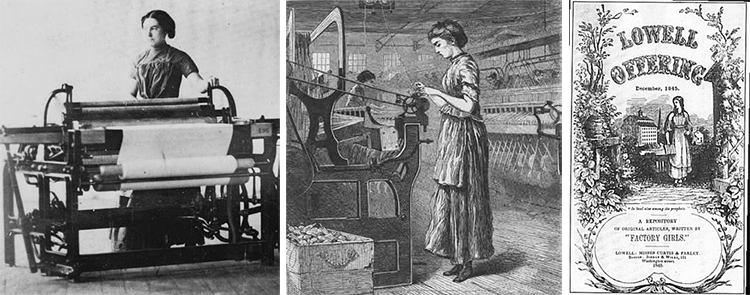
Many girls were motivated to work in the mills to support their families and to be in the city. They were forced to do difficult work and were treated poorly; that is, until the "Lowell Experiment" began. It was a way to convince more girls to come work in the mills (and parents to let their children work in the mills) by avoiding the negative aspects of mill work. A paternal system was put in place, with the corporation as a father figure and the boardinghouse keeper as the mother figure. This ensured the young girls would be protected.
Lowell Experiment pictures and book

There were many benefits as well as costs when a girl was making the decision to work in the mills. They were fed, had a place to live, got an education, and had time to be social; however, they had to leave their families, they weren't paid enough (which led to strikes), they lived with strangers, the work was dangerous and they weren't compensated, the overseers were strict and the owners weren't there to control them, there were crowded quarters, there was a risk of not getting married if they stayed in the mills, and if they lost their job they would be blacklisted.
Women usually worked in the homes during the 1800s. Seeing them in the mills was a huge change in the work force. The mill girls changed the perspective everyone had on women, proving that they could work outside of the home, especially away from their parents. They also changed everyone's view on them by writing and being educated, eventually becoming abolitionists and women's rights activists.